Everyone has lost a game and thought "he knew exactly where my Dark Templar were". Sometimes that is a great read. Sometimes it is not. Repalyzer's integrity review looks for evidence in the replay itself, so you can tell the difference with something better than a hunch.
One rule first: Repalyzer never declares anyone guilty. It lists clues and how strong each one is. You decide, and you can mark the game as reviewed, confirmed or a suspected bot.
Running the review
Open the game in Local Explorer and run the integrity review. Some checks run automatically in the background after import. The command scan and the hidden-unit scan run when you ask; the hidden-unit scan replays the game in a copy of the Brood War engine, so it needs StarCraft installed.
The summary gives a bottom line in one of three forms: clues worth a closer look, nothing strong but some things worth a glance, or no clues found. Note the exact wording of the last one: "This does not prove the game was fair."
What the review checks
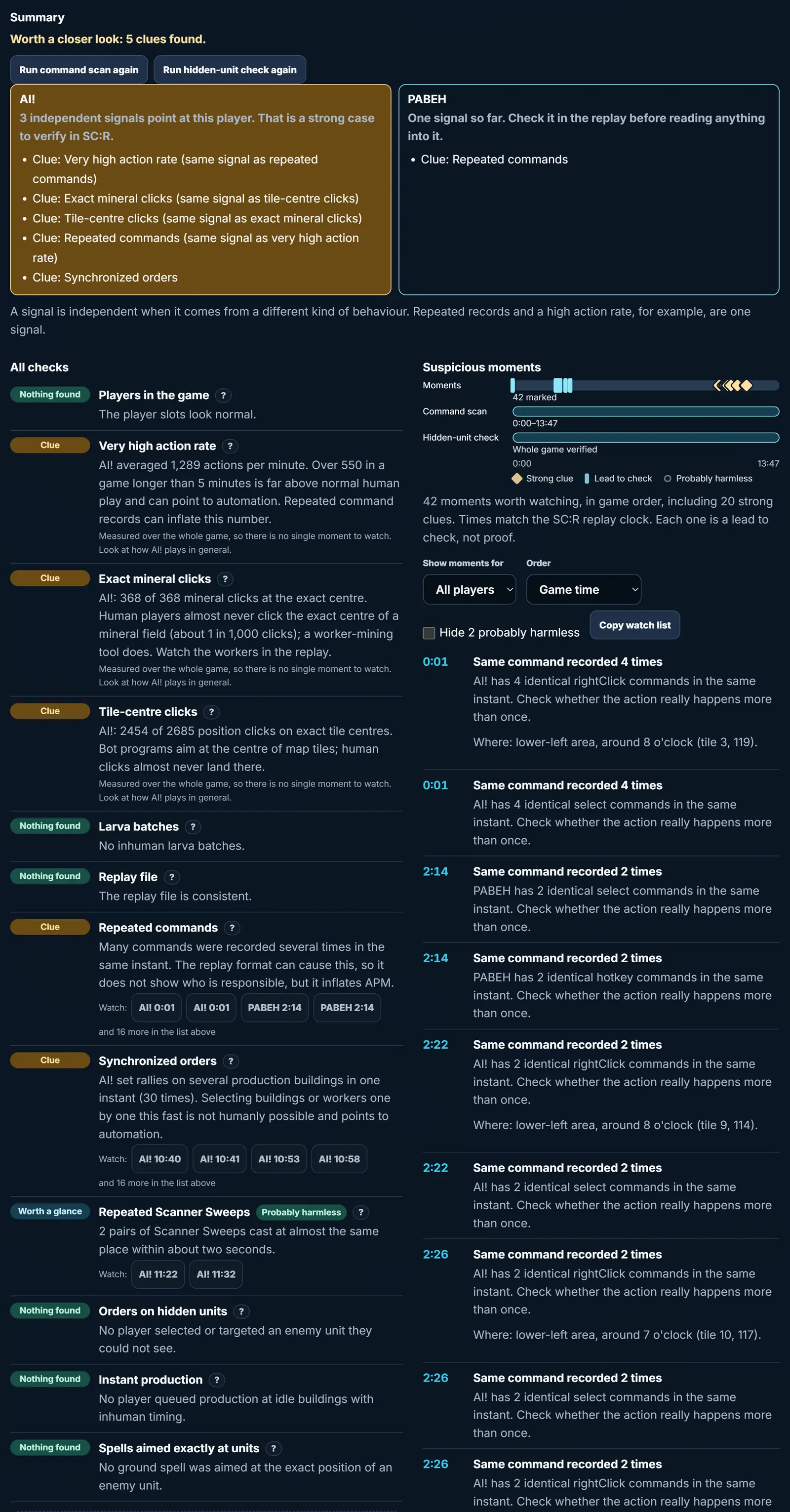
| Check | What it looks for | Why it matters |
|---|---|---|
| Orders on hidden units | Selecting or targeting an enemy unit that was never seen, hidden in fog, cloaked or burrowed and undetected | The game only allows this for units you can see, so it points to a map hack |
| Exact mineral clicks | Clicks on the exact centre of a mineral field | Humans do this about once in 1,000 clicks; worker-mining tools do it every time |
| Tile-centre clicks | Clicks on the exact centre of map tiles | Bot programs aim there; human clicks almost never land there |
| Very high action rate | Over 550 APM in a game longer than 5 minutes | Far above normal human play |
| Synchronized orders | Many separately selected units or buildings given orders in one instant, such as an instant worker split | One replay frame is about 42 ms; nobody selects ten buildings one by one that fast |
| Larva batches | Four or more larvae, each selected separately, morphed in one frame | Not humanly possible |
| Instant production | Queuing the next unit the moment a building finishes, again and again | What macro tools do; no progamer did it this often |
| Spells aimed exactly at units | Psionic Storm and other ground spells landing on the exact pixel of an enemy unit | Points to an aiming tool; human casts never did this in testing |
| Repeated commands, Scanner Sweeps | The same command recorded several times in an instant; two scans at the same spot within 2 seconds | Worth a glance only; the replay format and normal play can cause both |
| Players in the game, replay file | Unusual player slots for a ranked game; a replay file that contradicts itself | Extra computer players or an edited replay |
What a bot looks like
The live demo includes a game between Grast and a bot. Open it and the integrity review lights up: 368 of 368 mineral clicks at the exact centre, 2,454 of 2,685 position clicks on exact tile centres, and an average of 1,289 actions per minute. No single number proves anything, but when several extreme signals occur together, Repalyzer raises a strong automation clue.
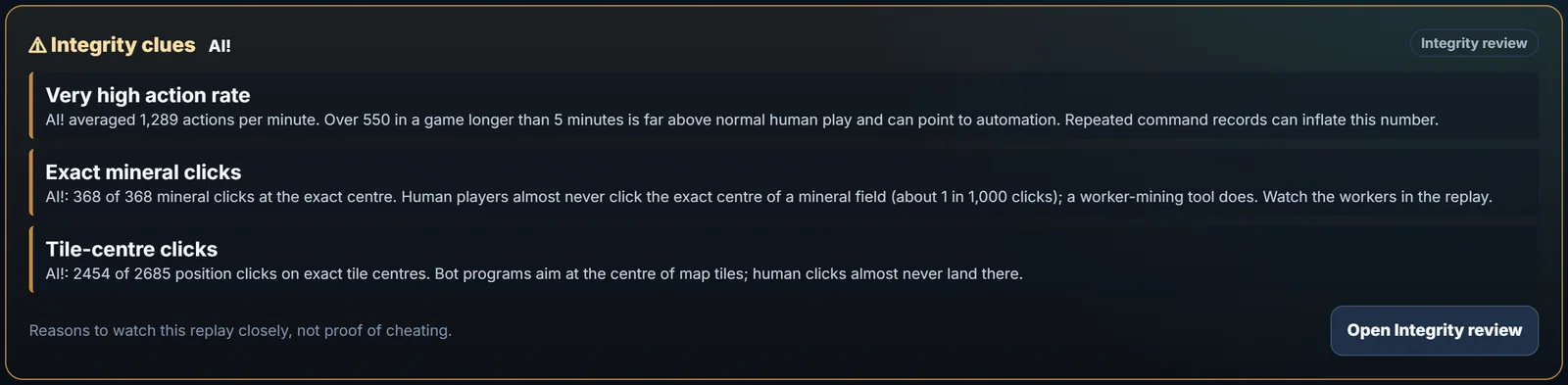
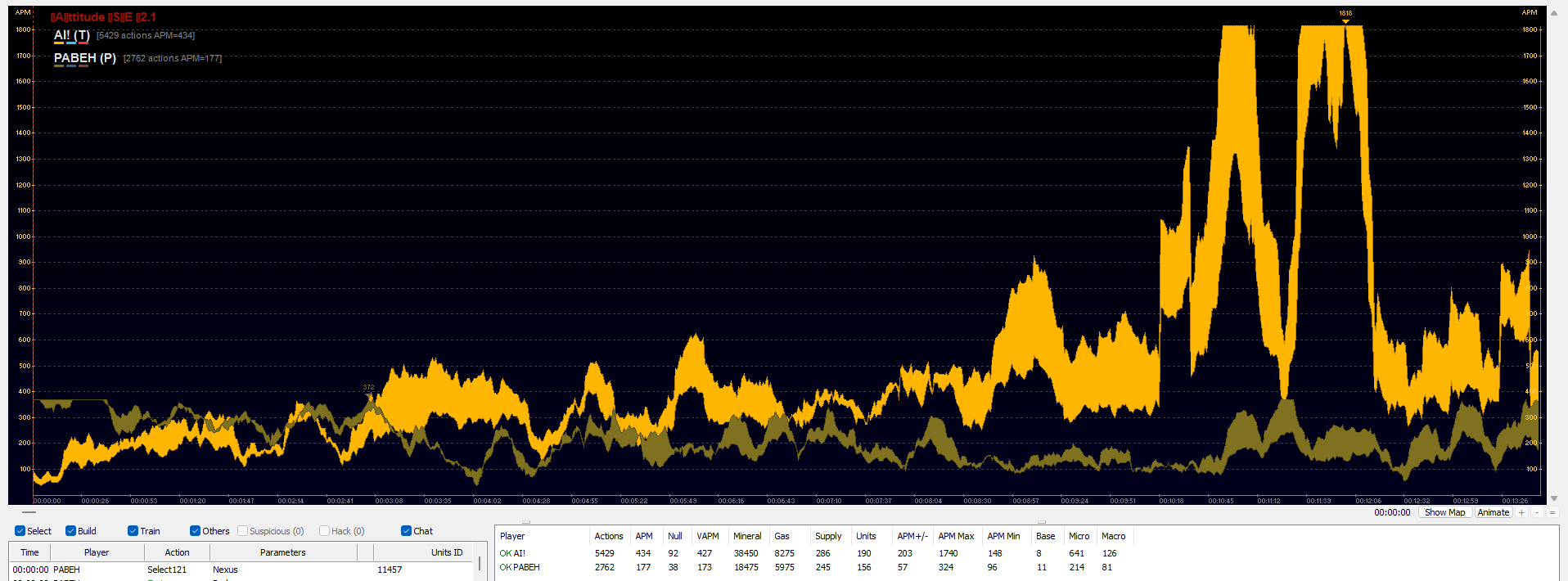
Each clue with a time is also marked on the game's charts. Click it to jump to that moment.
How to judge a map hack
The strongest map-hack clue is a player selecting or targeting a unit they could not see. Repalyzer tells you the unit, the moment and where on the map it happened. That is hard to explain any other way.
The weaker signs need your eyes. There is no automatic check for units moving toward enemies the player cannot see. Clicking into unexplored areas is normal play, and in testing it did not separate cheaters from honest players. Instead:
- Open the replay in StarCraft: Remastered.
- Switch to the suspect's vision.
- Watch whether their units head straight for hidden enemies again and again, without scouting first.
One pattern is a read. Five in one game is a habit.
And one myth to put away: resource hacks cannot show up in a replay. They would make a multiplayer game go out of sync instead.
Be fair
A few things that look suspicious but usually are not:
- High APM early in the game. Action rates in short games and in the opening minutes are inflated by warm-up spam. Repalyzer does not judge APM in games of 5 minutes or less.
- Repeated commands. A few commands recorded twice are common. They inflate APM but say nothing about who is responsible.
- A great read. Good players guess right. That is what makes them good.
If you do find strong clues, mark the game as confirmed or suspected bot so it shows up in your library filters.
What Repalyzer cannot see
Be realistic about map hacks. Unless a player uses one blatantly, a map hack is almost impossible to spot with Repalyzer. The clear cases are the ones above, like selecting a unit the player could not see. A careful cheater who only glances at the hidden map leaves no command that gives them away, and their good reads look just like a strong player's.
That limit comes with the design. Repalyzer is an offline tool: it works only on the replays in your own library, and it is there to help you personally. It cannot follow a player across other people's games or across the other nicknames they play under.
For that wider view, look the player up on sagi.gg and see whether they are marked as a cheater. Its detection system has learned from more than 1,000,000 replays and follows a player's behaviour over time, even across several nicknames of the same person.
Spotted a cheater? Report them on the sagi.gg Discord server and include the replay, so other players don't have to face them again.
Practice task
Open the bot game in the live demo and read every clue it raises. Then run the integrity review on five of your own recent losses. Most will come back clean, and that is useful to know too.